TCL CSOT Drives Limitless Future Mobility with Intelligent Cockpit Display Suite 3.0 at SID Display Week 2026
LOS ANGELES, May 7, 2026 /PRNewswire/ -- TCL CSOT, a global leader in advanced display technologies and a subsidiary of TCL Technology, is presenting a holistic vision for the future of mobility at SID Display Week 2026. For automotive applications, TCL CSOT demonstrates how different in‑car positions and functions can be served by diverse display technologies — from Inkjet-printed OLED (IJP OLED) to Micro LED to LCD — each tailored to specific needs. At the center of this vision is the Intelligent Cockpit Display Suite 3.0, a flagship solution that integrates these technologies into a unified ecosystem, redefining how drivers and passengers interact with the vehicle.
Intelligent Cockpit Display Suite 3.0: A New Benchmark for In-Car Displays
At the heart of the suite are two world‑first innovations: the World's First IJP OLED Sliding Central Control Display (28") and the World's First IJP OLED Curved Armrest Display (28"). Both are built on the same IJP OLED technology, which is inherently flexible and can be adapted into countless other shapes and applications beyond the two showcased today. This versatility, combined with TCL CSOT's decade‑long leadership in IJP OLED and the construction of its world's first 8.6‑generation IJP OLED production line (t8), sets a new standard for cockpit innovation. These innovations redefine the in‑car experience with superior image quality, power efficiency, and design flexibility at reduced cost.
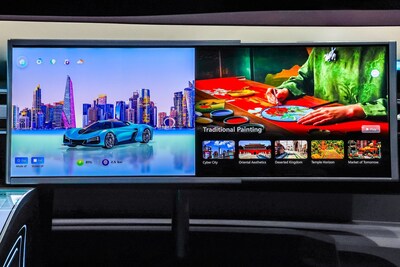
- The World's First IJP OLED Sliding Central Control Display (28") features an innovative curling design that allows free extension and retraction, injecting a futuristic feel into the cabin. When parked, it can be fully stored to release space; during driving, it unfolds with a single touch to serve both driver and passenger applications. Flexible display modes — ½, ⅔, or full screen — support multi‑scenario use, while split‑screen functionality enables navigation, entertainment, and vehicle control to run in parallel. Deeply integrated with the intelligent ecosystem, it transforms static aesthetics into dynamic interaction, making every trip a dual experience of technology and comfort.
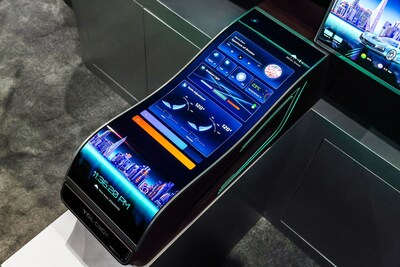
- The World's First IJP OLED Curved Armrest Display (28") complements this innovation by combining IJP OLED's vivid clarity with ergonomic design. Its curved form enhances fingertip sliding and visual extension, breaking the limitations of traditional flat screens. From intuitive interconnection to seamless scene‑based applications, it empowers travel with technology, redefining comfort and efficiency while adding a sense of occasion to every interaction.
Together, the sliding and curved IJP OLED displays balance practicality with futuristic elegance, elevating the cockpit into a truly immersive environment.
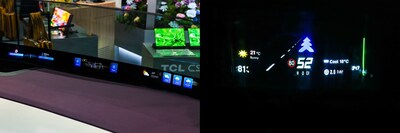
Complementing the OLED centerpiece are advanced HUD solutions that expand the ecosystem of intelligent displays. The World's First Ultra High Brightness Micro LED AR‑HUD Display (4.6") projects crystal‑clear images directly onto the windshield, achieving 18,000 nits of luminance at the eye and a wide field of view that remains sharp even under direct sunlight. It provides intuitive navigation, safe driving cues, and immersive interaction. Meanwhile, the World-Leading High Brightness & Low-Power-Consumption P-HUD Display (12") reimagines the dashboard by projecting essential information — speed, navigation, and warnings — into a dedicated area within the driver's line of sight. This enables "zero eye movement" interaction, ensuring critical data is always accessible without distraction, while maintaining high brightness at remarkably low power.
Together, these innovations highlight TCL CSOT's vision of the cockpit as more than just a collection of displays — it is the intelligent hub of future mobility. By uniting IJP OLED, Micro LED, and LCD technologies, the suite creates a seamless environment where information, interaction, and design converge. The result is a driving experience that feels intuitive and immersive, with displays that adapt fluidly to both functional needs and aesthetic expectations.
About TCL CSOT
Established in 2009, TCL China Star Optoelectronics Technology Co., Ltd. (TCL CSOT) is a leading global innovator in display technologies. Its LCD, OLED, and MLED solutions power applications across TVs, smartphones, tablets, laptops, monitors, automotive systems, VR/XR, and commercial displays. With a clear strategic direction set by its advanced display technology brand APEX, TCL CSOT invests continuously and strategically in R&D, driven by a mission to amaze, protect and inspire all people through endlessly innovative display technology. As part of TCL's Worldwide Olympic Partnership, TCL CSOT is proud to deliver display solutions that elevate experiences on the global stage.
Photo - https://mma.prnewswire.com/media/2974635/WhatsApp_Image_2026_05_07_1.jpg
Photo - https://mma.prnewswire.com/media/2974636/WhatsApp_Image_2026_05_07_2.jpg
Photo - https://mma.prnewswire.com/media/2974634/WhatsApp_Image_2026_05_07_3.jpg
 View original content:https://www.prnewswire.co.uk/news-releases/tcl-csot-drives-limitless-future-mobility-with-intelligent-cockpit-display-suite-3-0-at-sid-display-week-2026--302765396.html