Trina Storage Ranked Among Top 5 Global BESS Integrators and Awarded Grade A Status by Wood Mackenzie
Recognition highlights Trina Storage's Cell-to-AC integration capabilities, technology innovation, and growing global delivery footprint.
MUNICH, July 2, 2026 /PRNewswire/ -- Trina Storage, a global energy storage solutions provider, has been ranked among the world's Top 5 battery energy storage system (BESS) integrators and recognized as a Grade A BESS Integrator in Wood Mackenzie's latest Global Battery Energy Storage System Integrator Comprehensive Ranking 2026, reinforcing its position as a leading global provider of utility-scale energy storage solutions.
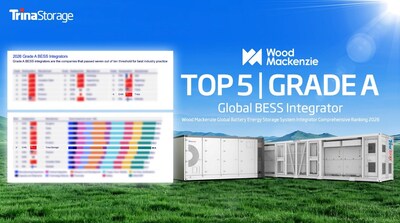
Published annually by leading energy research and consultancy firm Wood Mackenzie, the report evaluates BESS integrators across a broad range of criteria, including manufacturing experience, vertical integration, R&D capabilities, supply chain stability, technology maturity, financial strength, safety performance, and ESG commitments. In addition to ranking integrators globally, Wood Mackenzie awards Grade A status to companies that meet its highest qualification thresholds across key operational, technical, and financial indicators. The assessment is widely regarded as one of the industry's most authoritative benchmarks for evaluating the competitiveness and bankability of energy storage system providers.
"This recognition reflects the strength of our technology, execution capabilities, and commitment to delivering reliable storage solutions at scale," said Mr. Yang Bao, President of Energy Storage Division at Trinasolar. "As energy storage deployment accelerates globally, customers increasingly value partners that can combine innovation, quality, and delivery certainty. We are proud to see these efforts reflected in both our Top 5 ranking and Grade A classification by Wood Mackenzie."
A key factor behind Trina Storage's ranking is its expanding Cell-to-AC integration capability and growing global delivery track record. By integrating battery technology, AC-side conversion, and system integration within a unified solution architecture, Trina Storage enables greater control over system performance, project execution, and lifecycle value. This approach supports the increasing demand for reliable, bankable, and scalable energy storage deployments across global markets.
Continued investment in R&D further strengthens Trina Storage's technology and delivery capabilities. The company's advanced AC validation platform enables comprehensive verification of storage systems across real-world operating scenarios, including system integration, grid interaction, environmental testing, and EMS validation prior to deployment. Combined with robust supply chain management, internationally recognized certifications across major markets, strong ESG commitments, and sustained R&D investment, these capabilities contribute to Trina Storage's competitiveness across global energy storage markets.
The company's integrated delivery capabilities are exemplified by its recently announced Gamma project, where Trina Storage is delivering a fully integrated DC and AC solution featuring its Elementa + Electra solution. By integrating battery storage systems and AC-side technologies under a unified delivery model, the project demonstrates the company's ability to optimize system performance, streamline project execution, and reduce integration complexity for customers.
As the energy transition accelerates, Trina Storage remains committed to advancing storage innovation and supporting customers worldwide with bankable, scalable, and future-ready energy storage solutions.
More information is available on the Trina Storage website, Facebook and LinkedIn.
Photo - https://mma.prnewswire.com/media/3003295/image1.jpg
 View original content:https://www.prnewswire.co.uk/news-releases/trina-storage-ranked-among-top-5-global-bess-integrators-and-awarded-grade-a-status-by-wood-mackenzie-302816792.html