LONGi Awarded "2026 Climate Lighthouse" Outstanding Case of 2026 Shanghai Climate Week: Zero-Carbon Technology Leads Green Transition
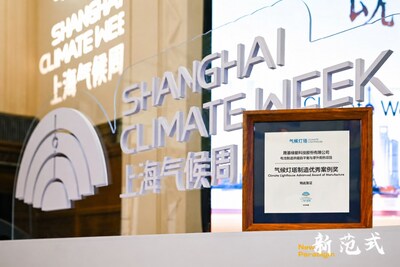
SHANGHAI, June 24, 2026 /PRNewswire/ -- The "2026 Climate Lighthouse" Conference, themed "Chain the Future, Co-create a New Climate Lighthouse Paradigm", was held during the Shanghai Climate Week. LONGi Green Energy Technology Co., Ltd. was recognized as an Outstanding Case of the "2026 Climate Lighthouse" for its "Battery Manufacturing Heating Self-Balancing and Zero External Heat Sourcing Project." Dr. Xie Tian, General Manager of LONGi's Strategic Management Center, was invited to the "Future Enterprise Leadership Forum" to share LONGi's practices and insights on governance-driven climate transition.
Zero-Carbon Technology Leads Green Transition in Solar Manufacturing
The "Climate Lighthouse" initiative was co-launched by Rockwell Automation and Shanghai Climate Week in 2024, focusing on climate-friendly transformation driven by smart manufacturing and digital technologies. This year's conference, held in partnership with multiple ecosystem collaborators, saw the release of the new paradigm series outcomes, highlighted by the white paper Climate Lighthouse Construction Guide. Since its inception, the initiative has collected over 500 advanced use cases and selected nearly 100 exemplary cases, spanning more than 100 industrial sub-sectors. This year, 42 outstanding cases received official certification, among them the project submitted by LONGi.
The award-winning project addresses the high heating demands of battery manufacturing scenarios in winter, systematically restructuring heating models and optimizing thermal energy utilization to meet critical requirements such as constant temperature and humidity, cleanroom environments, and continuous stable operation. It establishes a heating self-balancing and zero external heat sourcing system designed for advanced manufacturing environments. Through forward-looking holistic design, deep integration of process waste heat recovery, power system coupling, and lean environmental control, the project connects the full chain of heat source organization, system synergy, and operational optimization, shifting winter production heating from external dependence to internal self-balancing. The technical pathway has been validated at LONGi's Weibei facility and replicated at the Gaoling and Tongchuan plants, delivering a quantifiable and replicable low-carbon heating solution for manufacturing facilities with stringent environmental control requirements.
Notably, this is not LONGi's first recognition at the Climate Lighthouse awards. In 2025, LONGi's Jiaxing Production Base—the solar industry's first global dual benchmark of a "Lighthouse Factory + Zero-Carbon Factory"—received the "Shanghai Climate Week — Climate Lighthouse 2025 Manufacturing Lighthouse Model Award." This latest accolade further underscores LONGi's sustained leadership in green manufacturing transition and clean energy technology application.
Systematic Governance Drives Climate Transition, Co-creating a Zero-Carbon Ecosystem
At the "Future Enterprise Leadership Forum: Leadership – Good Governance Transition and Collaboration" roundtable during Shanghai Climate Week, Dr. Xie Tian, General Manager of LONGi's Strategic Management Center, emphasized that LONGi regards climate action as a core corporate strategy for its sustainable development, rather than a mere compliance requirement.
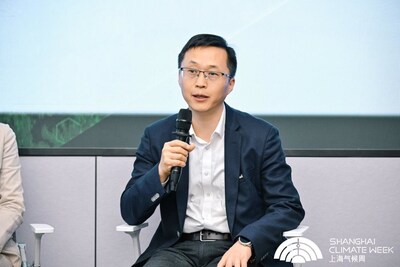
Dr. Xie Tian noted that governance mechanisms are the cornerstone of delivering on climate transition goals. LONGi has established a climate change governance structure with the Board of Directors at its core, setting up a Strategy and Sustainable Development Committee at the board level. Climate-related issues are integrated into the board's standing agenda, with meetings held regularly to review and approve the company's climate targets and transition plans on an annual basis.
On the operational front, Dr. Xie Tian shared outcomes of LONGi's value chain empowerment and just transition efforts. LONGi's Jiaxing Lighthouse Factory achieved a 20% reduction in energy consumption per unit of output through digital and smart upgrades, while exporting management methodologies and technical tools to small and medium-sized suppliers, helping supply chain partners lower their carbon costs. Meanwhile, LONGi is evolving from a module supplier into a scenario-based energy solutions provider, building a deeply decarbonized green energy ecosystem through its "Solar + Building Integrated Photovoltaics (BIPV), Solar + Energy Storage, Solar + Hydrogen" tripartite circular system.
"Leadership is not about walking alone, but building together," said Dr. Xie Tian. He highlighted that LONGi upholds an equal emphasis on "going global" and "local empowerment" in its overseas expansion—providing local communities with skills training and capacity building in power plant construction and operations, ensuring green energy truly takes root locally. He stressed that robust governance, transparent disclosure, proactive standards participation, and empathetic community empowerment together form the resilient foundation of LONGi's position in the global market.
The leadership of future enterprises, Dr. Xie Tian concluded, is no longer about competition through isolated breakthroughs, but the capacity for good governance transition and deep collaboration. LONGi is ready to work with global partners to co-create a "transparent, collaborative, and win-win" zero-carbon ecosystem.
Photo - https://mma.prnewswire.com/media/2999461/image1.jpg
Photo - https://mma.prnewswire.com/media/2999460/image3.jpg
Logo - https://mma.prnewswire.com/media/1606520/LONGi_Logo.jpg
 View original content:https://www.prnewswire.co.uk/news-releases/longi-awarded-2026-climate-lighthouse-outstanding-case-of-2026-shanghai-climate-week-zero-carbon-technology-leads-green-transition-302808907.html