Lilly launches "The Memory Radio Station" across Europe, inviting the public to visually reconstruct fading memories through GenAI
New multi-country campaign launches in Geneva alongside the European Academy of Neurology Congress
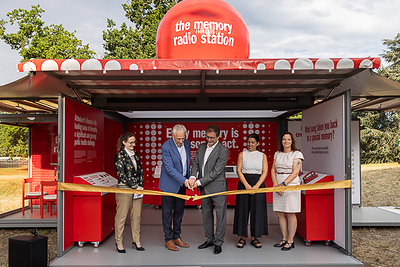
GENEVA, June 26, 2026 /PRNewswire/ -- Today, Eli Lilly and Company (NYSE: LLY) launches The Memory Radio Station, a travelling public radio station and exhibition dedicated to the memories that makes us who we are – and to raise awareness of the early symptoms of Alzheimer's disease and the importance of acting on even the smallest changes.
Launching at Palexpo in Geneva, alongside the European Academy of Neurology (EAN) Congress, The Memory Radio Station will travel to cities across multiple European countries including Austria, Germany, Italy and Belgium.
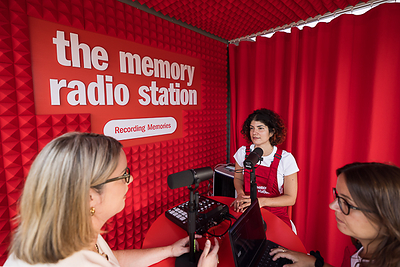
The Memory Radio Station carries an urgent message: every memory is a reason to act. Memories connect us to the people and moments that define us, but memory is fragile – and that fragility is precisely what calls us to act. Traveling from city to city, the campaign invites the public to share personal memories, dedicate songs tied to meaningful moments, and take part in guided sessions that use generative AI to give visual form to memories that were never photographed or have begun to fade.
The campaign launches at a critical moment for brain health in Europe, where disorders of the nervous system are now recognized as the leading cause of disability across the continent.1 Alzheimer's disease – the most common cause of dementia – can rob people of their memories, independence, relationships and ultimately their futures. It affected an estimated 9.5 million people in Europe in 2021, a figure projected to rise to 17.5 million by 2050.2 Despite its growing prevalence, Alzheimer's disease remains heavily underdiagnosed, with early symptoms often dismissed as part of normal aging.
Inside The Memory Radio Station*
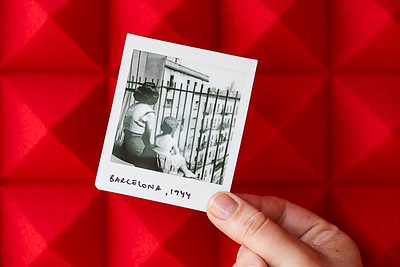
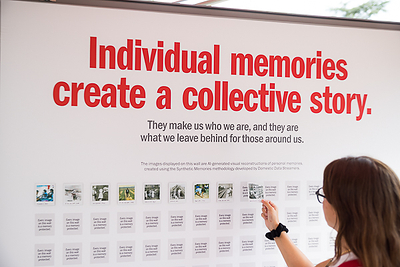
At the center of the experience is Synthetic Memories, a project at the intersection of community, arts and technology. Grounded in reminiscence therapy, it uses generative AI to give visual form to personal memories, including those that were never photographed or have begun to fade, helping people reconnect with the moments that shape their identity.3 In the Memory Radio Booth, visitors take part in sessions to share their stories. These stories are then transformed into prompts that generate images, which participants review and approve before being added to a living archive that continues to grow as the campaign travels across the continent.
At the booth, visitors can explore interactive installations focused on brain health and access educational materials.
Stéphane Epelbaum, Vice President, Medical IBU Neuroscience at Lilly, said: "Memory is deeply personal, but Alzheimer's disease is a shared challenge that touches millions of families across Europe. With The Memory Radio Station campaign, we want to meet people where they are – in public squares, in conversation, in the songs and stories that shape their lives. Our hope is that by discussing memory openly, we encourage more people to take early changes seriously. Noticing and acting early can make a meaningful difference for individuals and the people who love them."
Paul Boon, Brain Health Mission Co-Chair at EAN, said: "Brain health starts with awareness. By encouraging people to reflect on their memories and engage with them in new ways, we can foster a deeper understanding of how to protect cognitive wellbeing throughout life. Starting a conversation about memories is an opportunity to promote healthier brains for the future."
Airí Dordas, lead researcher at Domestic Data Streamers, said: "Memories are fragile and connected to deeply personal experiences. They are everyday moments that remain central to our identities and sense of belonging. The Memory Radio Station brings conversations about our memories into public spaces through a new form of memory storytelling using generative AI to visualize them. That is what makes this campaign meaningful to us: memory as a collective conversation, because every memory is a reason for connection. By bringing those stories into public spaces, we hope to create new ways for people to reflect on memory, brain health and what it means to preserve the moments that shape us."
The Memory Radio Station campaign has been developed through a partnership between Lilly and Domestic Data Streamers (DDS), combining expertise and scientific research in Alzheimer's disease, storytelling and immersive technology. The campaign reflects Lilly's ongoing commitment to advancing understanding of Alzheimer's disease and encouraging earlier conversations around memory changes and brain health.
*The experience is not a medical or therapeutic intervention and is not intended to diagnose, treat or assess any condition. All personal information is handled in accordance with applicable data protection laws, including the GDPR, and is not used for clinical research, commercial profiling or product promotion.
About Lilly
Lilly is a medicine company turning science into healing to make life better for people around the world. We've been pioneering life-changing discoveries for 150 years, and today our medicines help tens of millions of people across the globe. Harnessing the power of biotechnology, chemistry and genetic medicine, our scientists are urgently advancing new discoveries to solve some of the world's most significant health challenges: redefining diabetes care; treating obesity and curtailing its most devastating long-term effects; advancing the fight against Alzheimer's disease; providing solutions to some of the most debilitating immune system disorders; and transforming the most difficult-to-treat cancers into manageable diseases. With each step toward a healthier world, we're motivated by one thing: making life better for millions more people. That includes delivering innovative clinical trials that reflect the diversity of our world and working to ensure our medicines are accessible and affordable. To learn more, visit Lilly.com and Lilly.com/news, or follow us on Facebook, Instagram, and LinkedIn. C-LLY
About Domestic Data Streamers (DDS)
Domestic Data Streamers is a Barcelona-based collective whose Synthetic Memories project won the 2025 Ars Electronica Award for Digital Humanity, one of the world's most prestigious recognitions in media arts. DDS has worked in over 45 countries with cultural institutions including Tate Modern, the Barbican Center, and the California Academy of Sciences; organizations such as the United Nations, the World Food Programme and UNICEF; and brands including Spotify, Google and Cisco. DDS's research and work translate into films, installations, digital experiences, performances, or exhibitions in various contexts, such as schools, prisons, cinemas, museums, the streets of many cities, and the United Nations Headquarters. Learn more at www.domesticstreamers.com and https://www.syntheticmemories.net/
Trademarks and Trade Names
All trademarks or trade names referred to in this press release are the property of the company, or, to the extent trademarks or trade names belonging to other companies are references in this press release, the property of their respective owners. Solely for convenience, the trademarks and trade names in this press release are referred to without the ® and ™ symbols, but such references should not be construed as any indicator that the company or, to the extent applicable, their respective owners will not assert, to the fullest extent under applicable law, the company's or their rights thereto. We do not intend the use or display of other companies' trademarks and trade names to imply a relationship with, or endorsement or sponsorship of us by, any other companies.
1 The Lancet Neurology. Europe at a brain health crossroads. The Lancet Neurology. 2026. Available at: https://www.thelancet.com/journals/laneur/article/PIIS1474-4422(26)00132-8/fulltext
2 Maresova P, Rezny L, Bauer P, et al. Nonpharmacological intervention therapies for dementia: potential break-even intervention price and savings for selected risk factors in the European healthcare system. BMC Public Health. 2024;24:1293.
3 Klein, SB, Nichols S. Memory and the sense of personal identify. Mind. 2012;121(483):677-702.
Refer to: | Emi Yasukawa; emi.yasukawa@lilly.com (Media) |
Michael Czapar; czapar_michael_c@lilly.com (Investors) |

 View original content to download multimedia:https://www.prnewswire.co.uk/news-releases/lilly-launches-the-memory-radio-station-across-europe-inviting-the-public-to-visually-reconstruct-fading-memories-through-genai-302811677.html