GCL SI Officially Launches Back-Contact Modules at Intersolar Europe 2026
MUNICH, June 23, 2026 /PRNewswire/ -- GCL System Integration Technology Co., Ltd. ("GCL SI" or "the Company") has announced at Intersolar Europe 2026 held from June 23 to 25 in Munich to officially establish back-contact (BC) cell technology as the core strategic pillar of its next-generation photovoltaic roadmap, as a response to the rising demand for high-efficiency, aesthetically driven solutions. It also unveiled the GPC 3.0 full-screen all-black module at one of the most influential solar industry trade fairs worldwide.
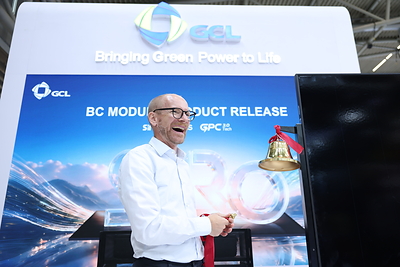
As China's solar sector faces mounting efficiency bottlenecks and increasingly diverse end-market demands, the shift to BC technology is driven by both evolving market needs and the company's accumulated expertise in passivation and contact techniques.
"BC is the ultimate architecture for crystalline silicon cells," said GengWeng Huang, Executive Dean of GCL SI's Cell Research Division. "We've already explored TOPCon and HJT extensively, but both are reaching their physical limits. BC is opening a broader window for future efficiency gains."
GCL SI's GPC (Graphical Precise-doping Passivation Contact) product line is its flagship BC technology development. GPC 3.0 targets the premium distributed segment of residential rooftops, C&I rooftops, and BIPV-style applications, where full-screen all-black aesthetics, higher energy yield, and stronger reliability are increasingly valued. GCL SI describes GPC 3.0 as a high-efficiency BC-based module designed to deliver greater real-world rooftop value.
Notably, GCL SI confirmed that the first containers of GPC 3.0 modules are already on their way to Europe, marking the beginning of its commercial rollout in the European distributed solar market.
The GPC residential full-screen all-black modules offer a proven benchmark: 475–500 W output, 23.27%–24.05% efficiency, dimensions of 1,800 × 1,134 × 30 mm, a 30-year linear power warranty with 0.35% annual degradation, and a 30-year product warranty. GCL SI has indicated that GPC 3.0 is designed to further enhance both efficiency and reliability beyond this baseline.
According to GCL SI, GPC 3.0 integrates several upgraded technologies including MAX design, advanced passivation, multi-layer gradient dielectric films, GPC metallization, and FBR granular silicon, to boost module efficiency, durability, and suitability across distributed scenarios. The technology offers four core advantages:
- Enhanced light harvesting & aesthetics: GPC 3.0's MAX‑oriented full‑screen design minimizes front‑side visual interruption while expanding light‑receiving area. Combined with multi‑layer gradient dielectric films, it delivers stronger broadband anti‑reflection and improved energy yield under variable rooftop irradiance.
- Higher conversion efficiency via passivation upgrades: GCL SI's advanced passivation path reduces surface recombination losses and boosts voltage performance. Mass‑produced GPC cells have achieved an average conversion efficiency of 28.38%, underscoring the company's BC‑track efficiency trajectory.
- Lower non‑silicon cost via metallization innovation: GPC metallization is a key lever in the GPC 3.0 upgrade. GCL SI also notes progress in advanced metallization such as 0BB and other silver‑reduction approaches, supporting the industry shift toward lower per‑watt silver consumption and improved cost resilience.
- Materials consistency & sustainability with FBR granular silicon: Leveraging in‑house FBR granular silicon, GCL SI enhances material uniformity and strengthens its sustainability profile, supporting both performance consistency and lower‑carbon manufacturing, which is increasingly valued in international distributed markets.
Looking ahead, GCL SI is committed to driving the global large‑scale adoption of BC technology to support worldwide carbon neutrality goals. With GPC 3.0 as a strategic cornerstone, the company will continue pushing efficiency boundaries and low‑carbon innovation across distributed solar applications, and to build a cleaner, more resilient energy future.
 View original content to download multimedia:https://www.prnewswire.co.uk/news-releases/gcl-si-officially-launches-back-contact-modules-at-intersolar-europe-2026-302808216.html