Dayspring Pharma Announces Positive Topline Results from Phase II Clinical Trial of CG2001 for the Treatment of Androgenetic Alopecia (AGA)
SEOUL, South Korea, June 8, 2026 /PRNewswire/ -- Dayspring Pharma, a clinical-stage biotechnology company focused on innovative dermatology therapies, announced the first public disclosure of positive topline results from its Phase II randomized, double-blind, placebo-controlled trial of CG2001 at the 14th World Congress for Hair Research (WCHR) in Seoul, South Korea. The results were presented orally by Professor Cheng Zhou, Director of the Department of Dermatology at Peking University People's Hospital.
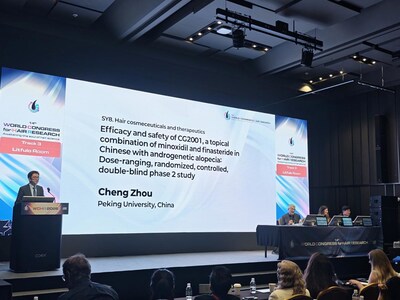
CG2001 is a topical fixed-dose combination formulation containing minoxidil and finasteride, being evaluated for the treatment of male androgenetic alopecia.
The trial consisted of the following treatment arms: CG2001 (5% Minoxidil and 0.075% Finasteride) once daily (QD); CG2001 (5% Minoxidil and 0.1% Finasteride) once daily (QD); CG2001 (5% Minoxidil and 0.075% Finasteride) twice daily (BID); and a Control Group.
The study met its primary endpoint: at Week 24, the group treated with CG2001 (5% Minoxidil and 0.075% Finasteride) twice daily demonstrated a statistically significant improvement in the change from baseline in Target Area Hair Count (TAHC) compared to the placebo group. Additionally, favorable safety and tolerability results were observed.
Key topline results include:
- At Week 24, the group treated with CG2001 (5% Minoxidil and 0.075% Finasteride) twice daily achieved an increase of 28.17 hairs/cm² from baseline in TAHC (p=0.006), a key efficacy metric, outperforming the placebo group, which showed an increase of 7.68 hairs/cm².
- In the CG2001 (Minoxidil 5% and Finasteride 0.075%) twice-daily group, a trend of sustained increase in ΔTAHC was observed at Weeks 6, 12, 18, and 24.
- In the CG2001 (Minoxidil 5% and Finasteride 0.075%) twice-daily group a trend toward improvement in subject self-assessments, were also observed.
- CG2001 was generally well-tolerated across all treatment groups, and no sex related adverse event were identified.
- All adverse events were mild to moderate in severity.
"Despite approved treatment options, androgenetic alopecia remains an area of significant unmet medical need. We are encouraged by the Phase II results, which support CG2001's potential as a differentiated treatment option and its continued clinical development," said Baohui Yu, CEO of Dayspring Pharma.
Dayspring Pharma is currently engaging with regulatory authorities to define the next phase of clinical development.
About CG2001
CG2001 is a topical combination of minoxidil and finasteride developed to harness the synergistic potential of two cornerstone therapies for AGA. Both are widely recognized as first-line treatments for male pattern hair loss: minoxidil promotes hair growth, while finasteride inhibits 5α-reductase and reduces dihydrotestosterone levels.
CG2001 is formulated as a specifically designed foam with an optimized dose ratio and delivery system to improve local follicular delivery, enhance efficacy, and minimize systemic exposure associated with oral finasteride.
About Dayspring Pharma
Dayspring Pharma is a pharmaceutical company focused on innovation in dermatology and hair health. The company develops differentiated therapies to address unmet clinical needs. For more information, please visit dayspringpharma.com.
Contact: Dayspring Pharma, chenguang@dayspringpharma.com
Photo - https://mma.prnewswire.com/media/2993074/image1.jpg
 View original content:https://www.prnewswire.co.uk/news-releases/dayspring-pharma-announces-positive-topline-results-from-phase-ii-clinical-trial-of-cg2001-for-the-treatment-of-androgenetic-alopecia-aga-302792544.html